Source: Ketut Subiyanto/Pexels
Packing clothes may look like one of the easier parts of moving, but a full closet can take hours to empty, fold and reorganize. Dresses, suits, dress shirts and winter coats can also become wrinkled or damaged when squeezed into regular moving boxes.
Wardrobe boxes provide a simple alternative. These tall boxes have a built-in hanging bar, allowing clothes to remain on their hangers throughout the move. You can transfer garments directly from your closet into the box and hang them in your new closet after arriving.
But wardrobe boxes come in different sizes, and they cost more than ordinary cardboard boxes. How many should you use? Should you buy or rent them? And are they worth the extra expense?
This guide covers the common wardrobe-box sizes available in Canada, how to estimate the quantity you need and how to use them efficiently.
Quick answer
Occupied closet width in feet ÷ 1.5 = estimated number of wardrobe boxes
Always round up to the next whole box. For example, 3 feet of hanging clothes requires about two boxes, while 6 feet requires about four. A full-size box may hold closer to 2 feet (61 cm) of lightweight clothing, but 1.5 feet (46 cm) is the safer estimate for bulky garments.
Table of contents
- What is a wardrobe box?
- Is there a standard wardrobe-box size in Canada?
- How many wardrobe boxes do you need?
- Which clothes should go in wardrobe boxes?
- How wardrobe boxes save time
- Should you buy or rent wardrobe boxes?
- How to pack a wardrobe box properly
- Common wardrobe-box mistakes
- Are wardrobe boxes worth it?
What is a wardrobe box?
A wardrobe box is a tall moving box designed for clothing that normally hangs in a closet. It includes a horizontal bar made from metal, reinforced cardboard or another strong material.
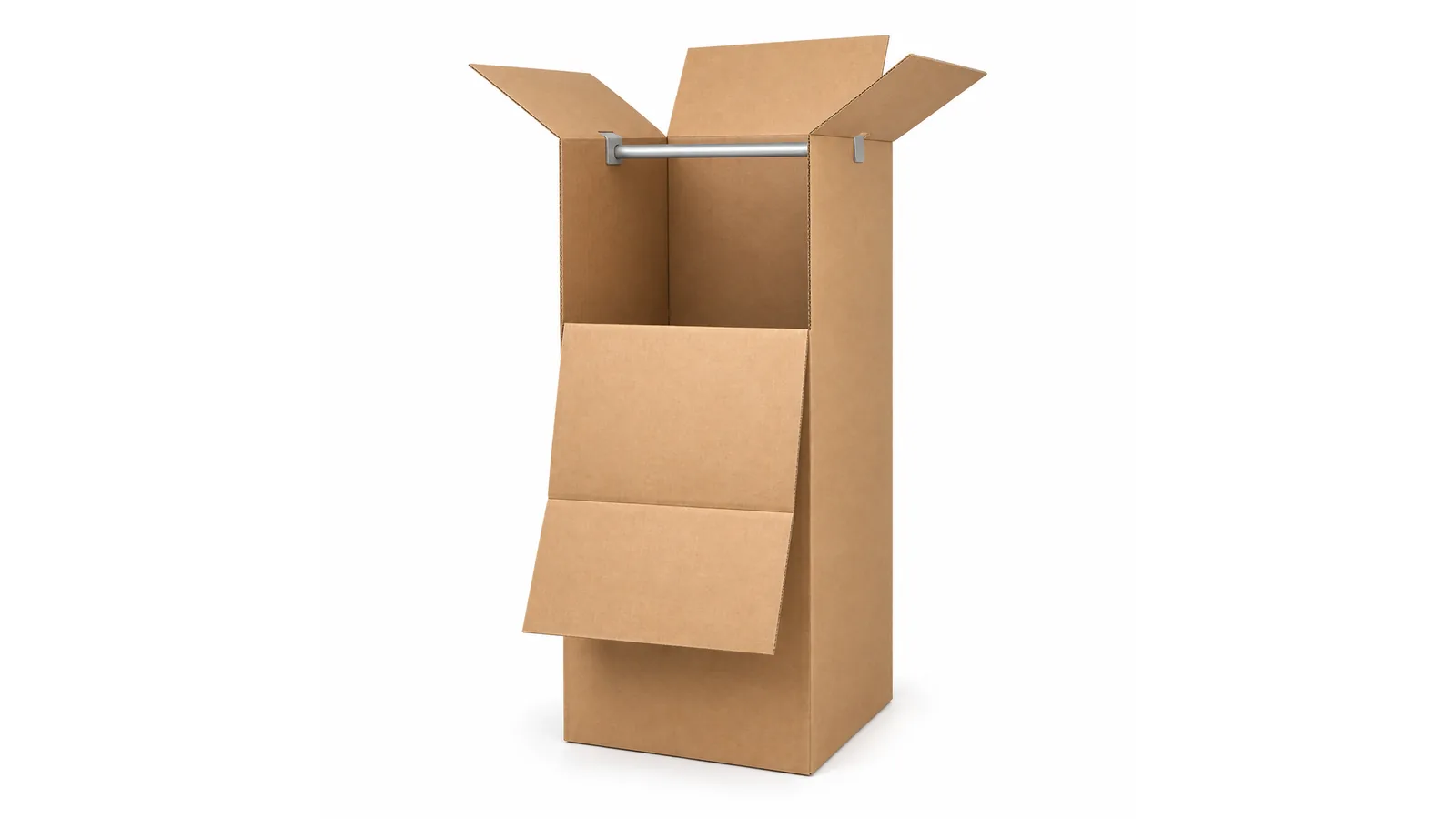
Rather than removing hangers and folding each garment, you transfer your clothes directly onto the box’s bar. Once the box is closed, its sides help protect the clothing from dust, contact with other belongings and some of the movement that occurs during transportation.
Wardrobe boxes are particularly useful for:
- Dresses
- Suits and blazers
- Dress shirts
- Skirts and dress pants
- Uniforms
- Winter coats and jackets
- Delicate or wrinkle-prone garments
- Curtains and drapes
You probably won’t need wardrobe boxes for your entire closet. T-shirts, sweaters, jeans, sportswear and other items that fold easily can usually travel in regular boxes, suitcases or reusable plastic bins.
For a complete clothing-packing plan, see our step-by-step guide to packing clothes. You can also read how to pack clothes for moving from our sister company MoveMate.
Is there a standard wardrobe-box size in Canada?
Wardrobe-box dimensions vary by supplier and model. Retailers, packaging suppliers and moving companies carry different models, so terms such as “standard,” “large” and “tall” do not always refer to the same dimensions.
Most products fall into three general categories.
Space-saving wardrobe boxes
A common space-saving model measures approximately 18 × 18–21 × 46 inches, or 46 × 46–53 × 117 centimetres.
For example, the U-Haul Space Saver wardrobe box measures 18 × 21 × 46 inches, or approximately 46 × 53 × 117 centimetres. U-Haul lists a capacity of 1.5 feet of closet space and a maximum box weight of 100 lb, or about 45 kg, for this model.
However, that weight limit belongs to the individual box—not to wardrobe boxes as a category. Always follow the limit printed on the product.
Space-saving boxes are easier to fit into cars, smaller moving trucks and storage areas. Their height makes them suitable for many dresses and winter coats, but their narrower bar holds fewer garments.
Shorter wardrobe boxes
For a shorter example, Home Depot Canada’s tall wardrobe box measures 20 × 20 × 39 inches, or approximately 51 × 51 × 99 centimetres.
These boxes are well suited to shirts, blazers, folded pants and shorter jackets. They may not provide enough vertical space for long coats, gowns or full-length dresses.
Before purchasing one, measure your longest garment from the top of its hanger to its lowest point. Compare that measurement with the usable height from the box’s hanging bar to its bottom, rather than the external box height.
Full-size wardrobe boxes
Traditional full-size wardrobe cartons are often approximately 24 × 20–21 × 46–48 inches, or 61 × 51–53 × 117–122 centimetres.
For example, Uline’s double-wall wardrobe box kit measures 24 × 20 × 46 inches and includes a 24-inch bar. The U-Haul Grand wardrobe box measures 24 × 21 × 48 inches and is listed as holding two feet of closet space.
Their wider bar can accommodate more hanging clothes, and their additional height works well for long garments. However, full-size boxes are bulkier, more difficult to carry and may not fit easily inside a passenger vehicle.
Which size is most common?
These examples show why it is better to compare actual dimensions than labels such as “standard” or “tall.” The best choice depends on:
- The length and thickness of your clothes
- The amount of hanging space you need
- Your vehicle or moving-truck dimensions
- The strength of the box and hanging bar
- Whether you are buying, renting or receiving boxes from a mover
How many wardrobe boxes do you need?
The most reliable method is to measure the occupied hanging space in your closet.
Use a tape measure to determine how much closet rod is currently filled by the garments you plan to place in wardrobe boxes. Do not measure empty space or clothing you intend to fold, donate or transport separately.
Most wardrobe boxes hold approximately 1.5 to 2 linear feet—or 46 to 61 centimetres—of hanging clothes. The exact capacity depends on the width of the hanging bar and the thickness of the garments. A full-size box may hold up to two feet of lightweight clothing, while bulky coats or a narrower box may hold closer to 1.5 feet.
For a conservative estimate, plan for one wardrobe box per 1.5 feet of occupied closet space and round up to the next whole box.
The table below uses an 18-inch (1.5-foot) hanging bar as its planning assumption. Allow additional space for bulky clothing and stay within the selected model’s weight rating:
| Occupied hanging space | Metric equivalent | Estimated boxes |
|---|---|---|
| 3 ft | 0.9 m | 2 |
| 6 ft | 1.8 m | 4 |
| 9 ft | 2.7 m | 6 |
| 12 ft | 3.7 m | 8 |
| 15 ft | 4.6 m | 10 |
Divide your occupied closet space by 1.5 feet and round up to the next whole number.
For example, if your hanging clothes occupy eight feet of closet rod:
8 ÷ 1.5 = 5.3
You should plan for approximately six space-saving wardrobe boxes.
The actual number depends on both the box and your clothes. Six feet of lightweight shirts may fit into three full-size boxes, while six feet of bulky winter coats could require four or more.
If you are unsure, use the more conservative 1.5-foot estimate. An extra empty box is easier to handle than an overloaded one.
Which clothes should go in wardrobe boxes?
Reserve wardrobe boxes for garments that benefit from remaining upright.
Good candidates include:
- Formalwear
- Business clothing
- Coats and jackets
- Long dresses
- Delicate fabrics
- Uniforms
- Clothing that wrinkles easily
- Items you need shortly after arriving
Regular boxes or suitcases are generally more economical for:
- T-shirts
- Sweatshirts
- Jeans
- Leggings
- Socks and undergarments
- Folded sweaters
- Pyjamas
- Gym clothes
Before deciding how many boxes you need, sort your closet into keep, donate, sell and discard categories. Decluttering first reduces the cost and effort of moving clothing you no longer wear.
How wardrobe boxes save time
Clothes remain on their hangers
You do not need to remove hangers, fold each garment and pack the hangers separately. Groups of clothing can move directly from the closet rod to the box.
Unpacking is faster
At your destination, lift the clothes from the wardrobe-box bar and place them in the new closet. There is less sorting and refolding than with regular boxes.
Less ironing and steaming may be required
Keeping garments upright reduces the deep folds that can occur when clothing is packed tightly. Clothes may still shift or wrinkle during transportation, but they are generally easier to prepare for wearing after the move.
Boxes can stay organized by destination
Each box can be assigned to one person, bedroom or clothing type. Labels such as “Main bedroom—work clothes” or “Entrance closet—winter coats” tell movers where the box belongs.
They provide temporary hanging space
If the closets in your new home are not ready, the boxes can act as temporary portable wardrobes. This is particularly helpful during renovations, delayed move-ins or short-term storage.
Should you buy or rent wardrobe boxes?
The better option depends on your schedule, location and whether your moving company provides packing materials.
Buying wardrobe boxes
Buying may be preferable when:
- You are packing over several days or weeks
- You need complete control over the schedule
- You are handling a DIY move
- You plan to reuse the boxes
- The garments will remain in storage
- Rentals are not available locally
Before buying, compare the box dimensions, bar material, construction and stated weight limit. Also confirm whether the hanging bar is included or sold separately.
Cardboard wardrobe boxes can often be flattened and reused if they remain clean, dry and structurally sound. Avoid reusing boxes with crushed corners, torn handles, water damage or weakened bottoms.
Renting wardrobe boxes
Renting may make sense when:
- You only need the boxes for moving day
- You do not have space to store them afterward
- You prefer reusable materials
- Delivery and pickup are included
- You are moving locally
- Your moving company offers them at a reasonable rate
Ask how long you can keep the boxes, whether additional days cost extra, and who is responsible for damage. Confirm whether the boxes must be empty immediately after delivery or can remain with you while you unpack.
Requesting wardrobe boxes from your mover
Some movers provide wardrobe boxes as an optional packing material. Depending on the company, they may charge per box, include them with a packing service or take reusable boxes away after the move.
Wardrobe boxes should be requested in advance because they may not be standard equipment on every truck. MovingWaldo’s frequently asked questions explain that specialty materials should be arranged before moving day and may involve additional fees.
If you want help with more than your closets, compare professional packing and moving options. Professional crews may be able to supply the boxes, pack the clothes and help with unpacking.
How to pack a wardrobe box properly
1. Declutter before packing
Remove clothing you no longer want. This reduces the number of boxes required and gives you more room to pack the garments you regularly wear.
2. Check and assemble the box
Follow the box manufacturer’s instructions. Secure the bottom carefully and ensure all tabs and supports are in the correct position.
Install the hanging bar before adding clothes. Check that it is seated securely on both sides.
3. Organize garments into groups
Group clothes by person, season, destination closet or garment type. Maintaining this organization makes unpacking easier.
4. Leave clothes on their hangers
Move several hangers at a time from the closet rod to the box. Distribute the weight evenly and follow the manufacturer’s loading instructions.
Avoid using damaged hangers that could snap or catch on delicate fabrics.

Image source: Priscilla Du Preez/Unsplash
5. Protect valuable or delicate garments
Garment bags can provide another layer of protection for wedding dresses, formalwear and delicate materials. Ensure clothing is clean and dry before packing it.
Do not place jewellery, identification, money or irreplaceable valuables inside a wardrobe box. Keep these items with you.
6. Avoid overpacking
Leave enough room for garments to hang naturally. Forcing too many clothes onto the bar can cause wrinkles, strain the box and make it difficult to lift.
Never assume the box supports 100 lb. Check the rating of the exact model you are using.
7. Use the bottom carefully
Some wardrobe boxes have room beneath shorter garments. You may use this space for lightweight items such as pillows, scarves or clean shoes in protective bags.
Avoid heavy objects. They can make the box unstable, damage the bottom or crush hanging garments.
8. Close and label the box
Close the flaps according to the instructions. Label at least two sides with:
- The person or room
- The type of clothing
- The destination closet
- “Keep upright,” when appropriate
Numbering the boxes—for example, “Wardrobe 1 of 4”—makes it easier to confirm that everything arrived.
9. Keep the box upright and dry
Wardrobe boxes are designed to stand vertically. Placing one on its side can push clothes off their hangers and place pressure on the bar.
Protect cardboard boxes from rain, snow and wet truck floors. Moisture can weaken the structure and affect clothing.
Common wardrobe-box mistakes
Avoid these frequent problems:
- Buying boxes without checking their dimensions
- Assuming all models support the same weight
- Packing clothes too tightly
- Using wardrobe boxes for every type of clothing
- Putting heavy items at the bottom
- Failing to secure the hanging bar
- Packing damp clothing
- Forgetting to label the destination closet
- Waiting until moving day to request boxes from the mover
A few minutes of measuring and planning can prevent buying too many boxes—or discovering that you do not have enough.
Are wardrobe boxes worth it?
Wardrobe boxes cost more and occupy more room than ordinary moving boxes. For folded everyday clothing, they are often unnecessary.
However, they can be worthwhile for hanging garments, formalwear, winter coats and clothes you want to unpack quickly. They reduce folding, keep clothing organized and make it possible to transfer garments directly between closets.
For most households, the best solution is a combination: wardrobe boxes for important hanging clothes and regular boxes, suitcases or reusable bins for everything else.
Measure your closet first and choose a box suited to the length of your garments. If you’re unsure whether you’ll need wardrobe boxes, packing services or other moving support, one of MovingWaldo’s booking agents can help you assess your needs while you compare quotes from trusted movers. With the right preparation and support, moving your closet—and the rest of your home—can be much simpler.